Union-Only Port Terminal Suspends Operations
Committee President Mark Mix: “If I were a Leatherman dockworker, I certainly wouldn’t count on Longshore Union bosses to show any flexibility” to get the terminal reopened and “save my job.”
In an Investor’s Business Daily op-ed this week, National Right to Work President Mark Mix exposes the collusion between United Auto Workers (UAW) union chiefs and General Motors (GM) management to secure yet another taxpayer bailout:
…GM leaders and the UAW officials who colluded with them to extract $43 billion out of taxpayers in exchange for arguably worthless stock are now patting themselves on the back for paying back on April 21 the balance of a $6.7 billion loan they took out from taxpayers as part of the 2009 bankruptcy package.
In a weekly radio address to the nation late last month, President Obama suggested that the fact that taxpayers have now recouped 14% of the taxes he diverted into GM coffers on their behalf vindicates his decision to bail out GM and the UAW brass.
But ordinary Americans, with whom the GM and Chrysler bailouts have become overwhelmingly unpopular over the past year, are unlikely to agree. Especially not if they learn that GM was able to “pay back” the loan only because it had not yet spent all of the other $43 billion in taxpayer money it raked in last year.
Read the rest of the op-ed by clicking here.
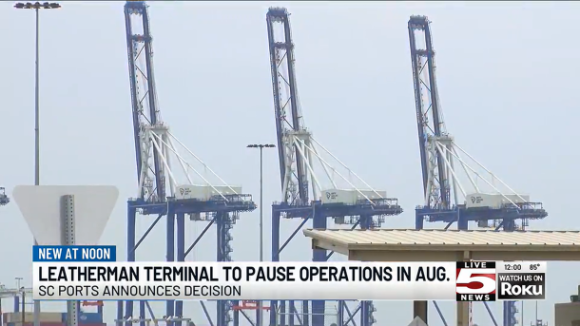
Committee President Mark Mix: “If I were a Leatherman dockworker, I certainly wouldn’t count on Longshore Union bosses to show any flexibility” to get the terminal reopened and “save my job.”
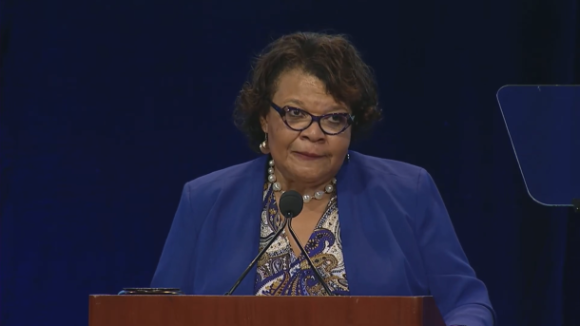
Incoming NEA President Princess Moss: Teachers Must Be Full-Time Political Activists
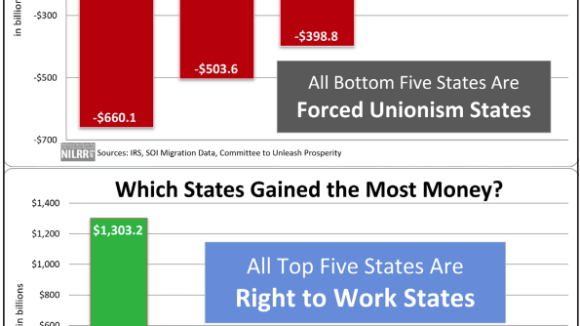
... States that continuously lacked Right to Work protections for employees from 2012-23 lost a net total of $2.05 trillion in cumulative AGI solely as a consequence of domestic out-migration of taxpayers during that 11-year period.