Union Special Privileges vs. Affordability
In addition to helping make the necessities and amenities of life more affordable, Right to Work laws help keep individual and family aggregate state-local tax burdens from spiraling out of control.
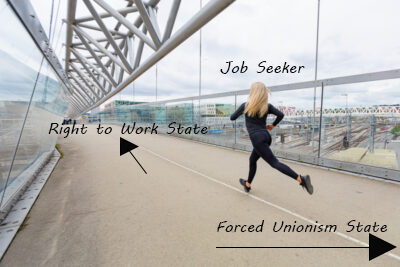
For years now, job seekers have been fleeing Forced Unionism states. And it’s no surprise as to why. Workers make less in Forced-Unionism states, and they still have to pay into the pockets of Big Labor. And the number of job seekers moving out of Forced Unionism states and into Right to Work states only continues to grow.
In an Op-Ed piece in CNS News, Stan Greer goes over a few key statistics, addressing the problem we’re seeing:
Between 2015 and 2016 alone, forced-unionism states lost a net total of $24.3 billion in adjusted gross income due to taxpayer flight to Right to Work states. The most recent available migration data, for the Tax Filing Year 2019, confirm that the cost of taxpayer flight is mounting for the 23 remaining forced-unionism states. […]
“A net total of roughly 212,000 tax filers moved from a forced-unionism state to a Right to Work state between 2018 and 2019. […]
Personal income tax filers moving out of a forced-unionism state between 2018 and 2019 reported a total of $150.5 billion in income in 2019, or $85,609 per filer. Tax filers moving into a forced-unionism state reported a total of $119.2 billion in income, or $77,090 per filer.”
Stan Greer, in CNS News
If you have questions about whether union officials are violating your rights, contact the Foundation for free help. To take action by supporting The National Right to Work Committee and fueling the fight against Forced Unionism, click here to donate now.

In addition to helping make the necessities and amenities of life more affordable, Right to Work laws help keep individual and family aggregate state-local tax burdens from spiraling out of control.

In response to a staffing crisis, the elected Lee County School Board (LCSB) approved an incentive plan to attract and retain teachers for high-need schools and hard-to-fill subject areas.

In the wake of Big Labor’s capture of the governorship and tightening of its grip over the Virginia General Assembly in last fall’s elections, union strategists are eager for passage of a law mandating union monopoly bargaining over the compensation and work rules of state and local civil servants.