Union-Only Port Terminal Suspends Operations
Committee President Mark Mix: “If I were a Leatherman dockworker, I certainly wouldn’t count on Longshore Union bosses to show any flexibility” to get the terminal reopened and “save my job.”
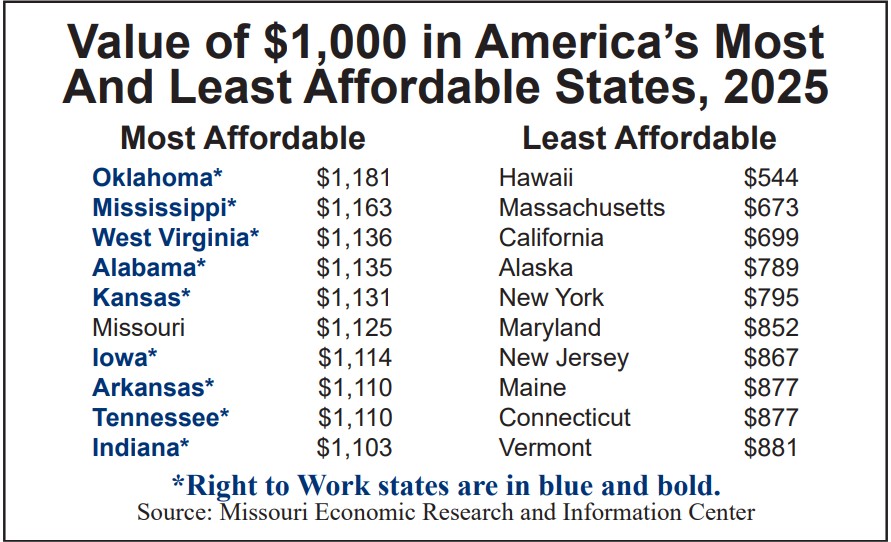
In early February, the Jefferson City-based Missouri Economic Research and Information Center, a state government agency, published its latest update of comparative state cost-of-living indices, covering 2025 as a whole.
As MERIC explains on its website, it “derives the cost of living index for each state by averaging the indices of participating cities and metropolitan areas in that state.”
(The city/metropolitan area indices are derived from an ongoing nationwide survey conducted by the nonpartisan, Arlington, Va.-based Council for Community and Economic Research.)
The MERIC indices released early this year estimate the average annual cost of living for each state, as well as for the District of Columbia.
The National Institute for Labor Relations Research has now used these data to calculate average 2025 costs of living for Right to Work states and forced-unionism states.
In 2025, 26 states had in effect Right to Work laws protecting employees from federal labor law provisions authorizing forced union dues and fees as a job condition.
The 26 Right to Work states combined had a population-weighted cost of living 4.3% below the national average. The 24 forced-unionism states combined had a cost of living 16.6% above the national average.
As a group, forced-unionism states are roughly 22% more expensive to live in than Right to Work states.
The correlation between forced-unionism status and a higher cost of living is robust.
Not one of the 15 highest-cost states has a Right to Work law. But nine of the 10 lowest cost-of-living states protected employees’ Right to Work in 2025.
John Kalb, vice president of the National Right to Work Committee, commented:
“A growing body of research shows that compulsory unionism fosters a higher cost of living. That’s not surprising.
“Union officials wielding forced-dues privileges funnel a large share of the conscripted money they reap into efforts to elect, and reelect, politicians who favor higher taxes and heavier regulation of business.
“The fact is, excessive government regulation is a major factor behind high housing, energy and other costs in forced-unionism states like California, Oregon, New York, Massachusetts and Connecticut.
“Decades of academic studies by economists such as Thomas M. Carroll and Richard J. Cebula have demonstrated that one side benefit of Right to Work laws is that they help reduce the cost of living in jurisdictions where they are in effect.”
Mr. Kalb continued:
“Recently, Big Labor politicians such as New York City socialist Mayor Zohran Mamdani and New Jersey Gov. Mikie Sherrill have sold themselves to voters by citing their alleged ability to make their jurisdictions more affordable for ordinary citizens.
“The reality is that there is no feasible way for any elected official to lower the cost of living substantially in forced-unionism strongholds like the Big Apple and the Garden State without reducing, rather than expanding, Organized Labor bosses’ special privileges.”
“Government-imposed union monopoly is a one-way ratchet to higher costs,” explained Mr. Kalb
“What matters most to employees is not nominal pay, but what those wages and salaries can buy in the location where they and their families live.
“That’s why honest efforts to make comparisons of annual wages and salaries and other types of income in Right to Work states versus forced-unionism states must always be informed by a nonpartisan comparative cost-of-living index.
“For example, in 2024, the average real, disposable income per capita in Right to Work states was nearly $2,900 higher than the average in forced-unionism states, using MERIC’s indices to adjust U.S. Commerce Department data for regional cost-of-living disparities.”
This article was originally published in our monthly newsletter. Go here to access previous newsletter posts.
To support our cause and help end forced unionism, go here to donate.
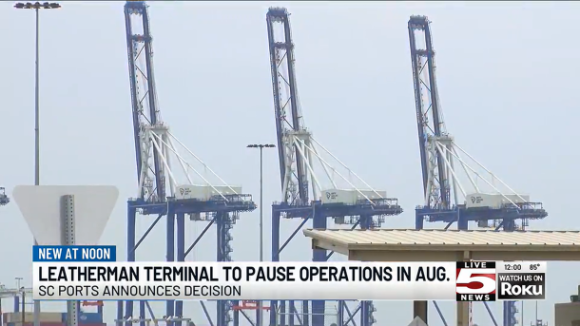
Committee President Mark Mix: “If I were a Leatherman dockworker, I certainly wouldn’t count on Longshore Union bosses to show any flexibility” to get the terminal reopened and “save my job.”

According to AFSCME Local 1632 President Will Harmon, Columbus Water & Power committed a grievous offense by subcontracting out the job of clearing away invasive weeds and brush spread out across two acres of its property to a tribe of roughly 40 goats without first “negotiating” with Big Labor.
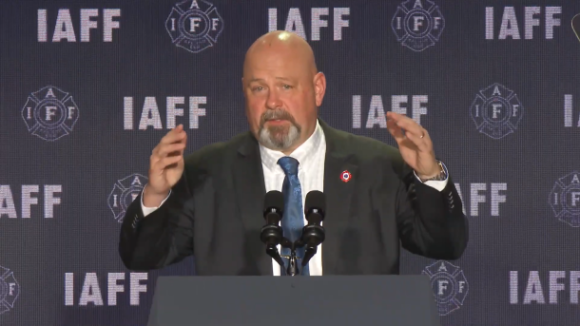
One longtime IAFF official who is now in the spotlight for his crass denigration of “two-hatters” -- that is, professional firefighters who also serve as volunteers -- is Pennsylvania Democrat politician Bob Brooks.