Radical Teacher Unions Get Even More Radical
Incoming NEA President Princess Moss: Teachers Must Be Full-Time Political Activists
 Writing for the Investor’s Business Daily, National Right to Work President Mark Mix summarizes what our victory in Indiana really means:
For the past two weeks, Big Labor bosses around the country have had their eyes on the Indiana capitol — watching in horror as the General Assembly passed a right-to-work bill with commanding majorities.
The passage of Indiana’s right-to-work law is an extraordinarily bitter defeat for the union brass. Less than a year ago, despite the fact that Hoosiers had elected substantial pro-right-to-work majorities to both chambers in 2010, union strategists remained confident they could preserve the forced-unionism status quo.
Last year, union bigwigs convinced the entire Democratic caucus of the Indiana House of Representatives to flee the state for five weeks in order to deny the body a quorum it needed to bring up and pass right-to-work legislation. Big Labor clearly believed whatever it lacked in legislative numbers it could make up for in zeal.
But polls showed Hoosiers overwhelmingly disapproved of the “fleabagger” tactic, and right-to-work supporters kept turning up the pressure on Republican Gov. Mitch Daniels and GOP legislative leaders to fight back against Big Labor.
Thanks to legislation passed after last year’s walkout, House members failing to show up to do their jobs when the General Assembly is in session may be hit with $1,000-a-day fines.
In the opening weeks of the 2012 session, House Democrats went public about their reluctance to jump over a cliff again for the union hierarchy. Finally, on Jan. 24, House Minority Leader Pat Bauer announced an end to his caucus’ boycott of the bill. It passed the next day.
Ever since, the caterwauling by Big Labor and its allies has resounded across the state. But what’s so bad about a law that merely says an individual shouldn’t be forced at the workplace to support financially an organization that he or she doesn’t believe acts in his or her interests?
Rather than address this question, union propagandists skirt it. Union officials never act contrary to the interests of any employee, they implicitly argue. Any employee who says otherwise they brand as a hypocritical “freeloader”!
For the stewards of a so-called “workers’ movement,” labor bosses have an unbelievably antagonistic attitude toward workers.
American charities collectively took in nearly $300 billion in 2010. Yet American workers can’t be trusted to support unions that supposedly represent their interests unless they are forced to do so? No law forces two-thirds of Americans to give to charity. And yet they do.
Union officials and their friends won’t acknowledge that being forced under federal or state law to accept a union as your monopoly-bargaining agent with your employer when it comes to pay, benefits and work rules is actually not in the economic interest of many employees.
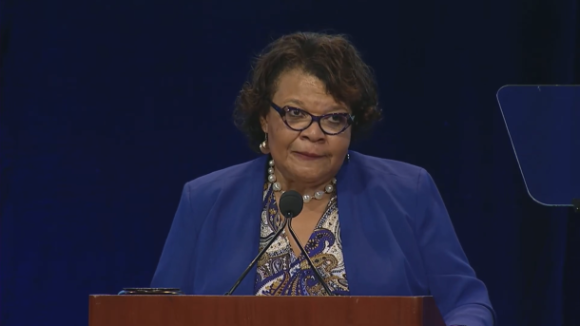
Incoming NEA President Princess Moss: Teachers Must Be Full-Time Political Activists
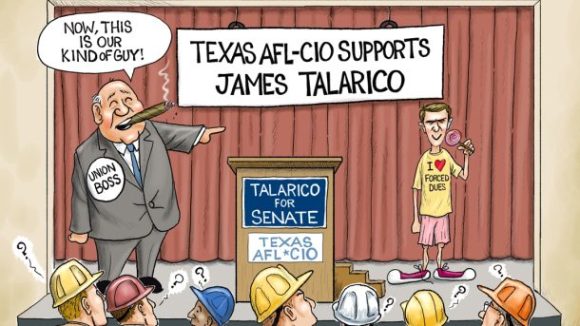
Union bosses are rallying behind Democrat Texas U.S. Senate candidate James Talarico because he opposes Right to Work protections for employees.
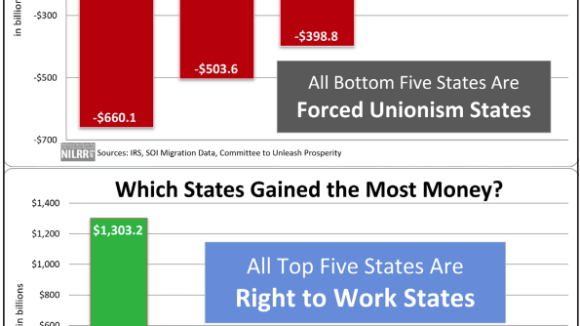
... States that continuously lacked Right to Work protections for employees from 2012-23 lost a net total of $2.05 trillion in cumulative AGI solely as a consequence of domestic out-migration of taxpayers during that 11-year period.