Big Labor’s Multi-Billion-Dollar Power Grab
Union bosses are rallying behind Democrat Texas U.S. Senate candidate James Talarico because he opposes Right to Work protections for employees.
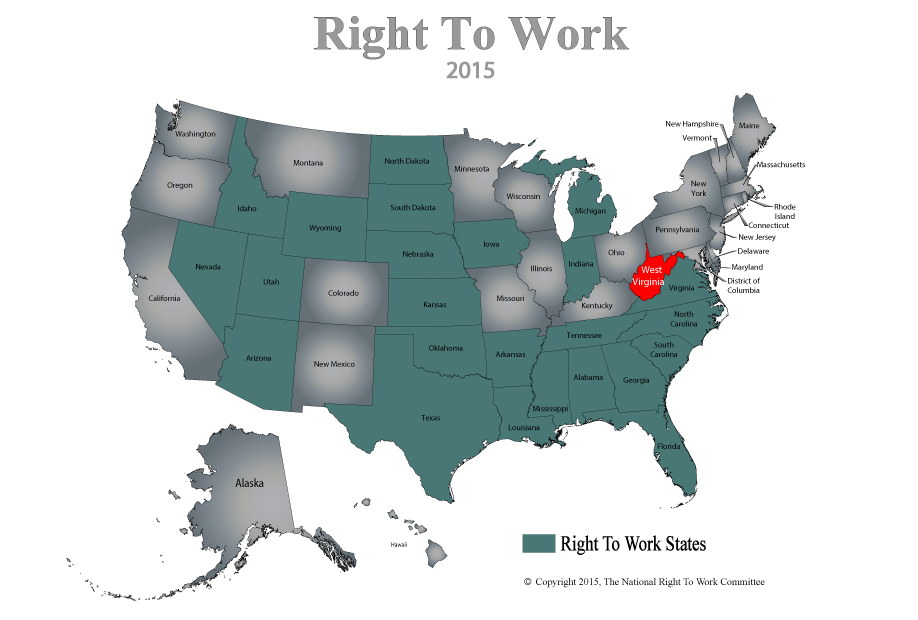
In the race to become the 25th Right to Work State, West Virginia and Kentucky share borders with each other and Ohio. The question is ‘which state will open the flood gates of freedom first?’
New West Virginia poll reveals that only 28 percent oppose a West Virginia Right to Work Law.
From the West Virginia MetroNews Network: More than 66 percent of West Virginia’s registered voters support the creation of a right to work law in West Virginia, according to a new poll from Mark Blankenship Enterprises conducted on behalf of Americans For Prosperity – West Virginia.
“It tells me people are ready for change,” said Wendy McCuskey, state director for AFP West Virginia, of the poll’s results. “People want jobs in West Virginia and I think right to work is the jobs bill.”
On Monday’s MetroNews “Talkline,” McCuskey said the poll showed three in five respondents backed the idea. In that poll, the support was highest among Independent voters, at 77 percent, followed by Republicans, at 70 percent, and Democrats, at 60 percent.
A total of 28 percent of voters said they opposed such a proposal.
A right to work law would prohibit any requirement that a person become or remain a member of a labor organization as a condition of employment; prohibit a requirement that any dues or fees be paid to a labor organization and prohibit any requirement that a person contribute to a charity instead of paying dues or other fees to a labor organization.
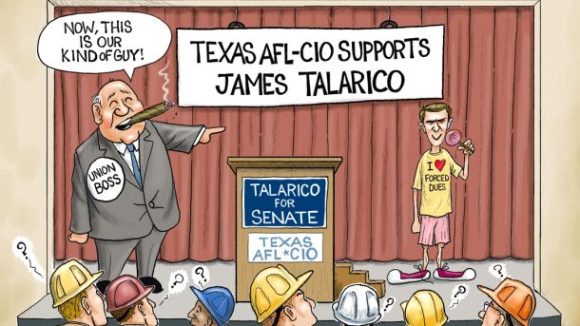
Union bosses are rallying behind Democrat Texas U.S. Senate candidate James Talarico because he opposes Right to Work protections for employees.
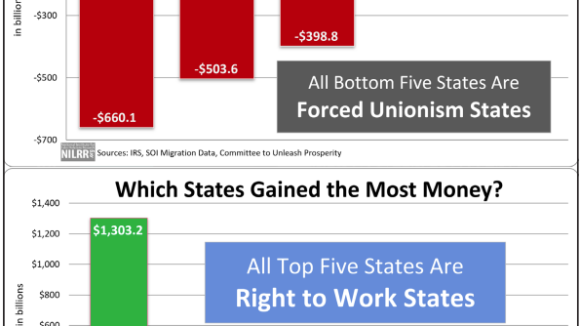
... States that continuously lacked Right to Work protections for employees from 2012-23 lost a net total of $2.05 trillion in cumulative AGI solely as a consequence of domestic out-migration of taxpayers during that 11-year period.
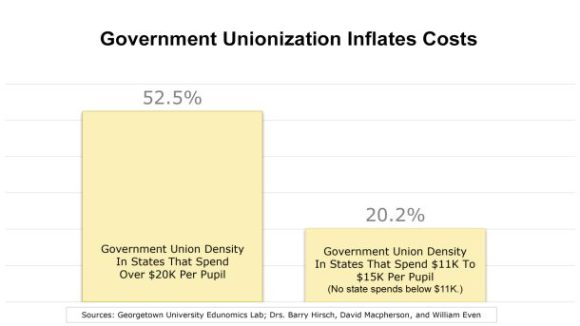
“[L]ast month, state legislation championed by AFSCME and coalition partners [...] was reintroduced to expand collective [monopoly] bargaining . . . to all Virginia public [workplaces]. It is supported by Gov. Abigail Spanberger.”