Union-Only Port Terminal Suspends Operations
Committee President Mark Mix: “If I were a Leatherman dockworker, I certainly wouldn’t count on Longshore Union bosses to show any flexibility” to get the terminal reopened and “save my job.”
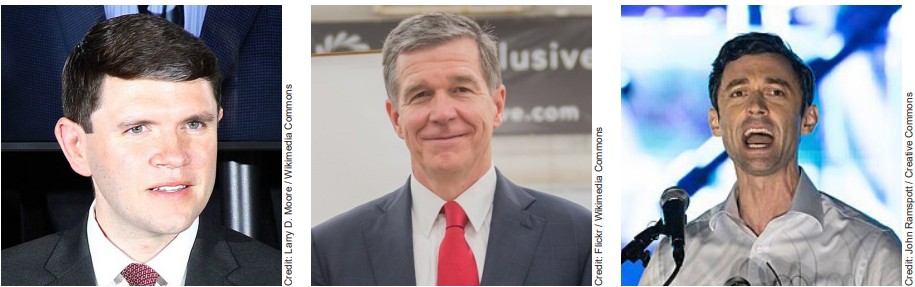
This year, Big Labor is mounting a massive, forced union dues-funded drive targeting federal incumbents and challengers who have pro-Right to Work or mixed records on labor policy.
But National Right to Work Committee members and supporters across the country are fighting back through their active participation in the federal Committee Survey 2026 citizen mobilization program.
Committee President Mark Mix commented: “Pro-Right to Work citizens want a Congress with the fortitude to take away the forced-dues privileges that union bosses have wielded for nine decades. Survey 2026 is critical for this objective.”
This program’s strategy is to make sure that pro-forced dues candidates are held accountable for their voting records and their campaign positions.
This year, there are open Senate seats in battleground states like Iowa, Michigan, North Carolina, and New Hampshire, plus a union boss-controlled senator who must face the voters again in Right to Work Georgia. Meanwhile, a myriad of House seats all across the nation are up for grabs.
“There are plenty of opportunities for Right to Work members and supporters to hold candidates to account,” observed Mr. Mix.
Outreach for Survey 2026 began at the start of the year in the states with the earliest primaries, the most notable of which is Texas.
The congressional map in Texas this year differs substantially from two years ago due to the mid-decade redistricting approved by state lawmakers in 2025.
The new borders for U.S. House districts have necessitated increased mobilization of Committee supporters to contact their candidates. It is critical 2026 candidates understand the importance of worker freedom — and are prepared both to defend the Lone Star State’s Right to Work protections and to fight to extend them nationwide should they be elected to office.
Mr. Mix continued: “Our enhanced efforts have paid off. 2026 is probably our most successful early survey collection effort ever in Texas.
“Every GOP nominee or runoff candidate for an open seat rated from ‘Safe Republican’ to ‘Tossup’ by political analysts returned a survey, pledging 100% support for Right to Work.
“This success extended to the Senate primary. Each of the three most prominent Republicans in the race — Sen. John Cornyn, Rep. Wesley Hunt, and Texas Attorney General Ken Paxton — returned his survey well in advance of the primary.
“Republican unity on Right to Work will be key going into the fall, with the union bosses’ handpicked candidates, such as Democrat Senate nominee James Talarico, vowing to battle to repeal by federal fiat Texas’s Right to Work law — which has been in place for almost eight decades.”
Similar success was achieved in U.S. House primaries in North Carolina, where virtually every Republican candidate with a potentially competitive race in November returned a survey before his or her primary in March.
The drive to collect surveys continued into Georgia, a long-time Right to Work stronghold, which — due to unique circumstances during the pandemic — elected union-brass lackey Jon Ossoff to the Senate almost six years ago.
“We are endeavoring to sway all three leading Republican candidates for the Georgia Senate seat to sign our survey. Fortunately, each of them has already publicly demonstrated support for our issue,” observed Mr. Mix.
“Meanwhile, in some open House seats, we are urging our members and supporters to reach out to candidates to get their commitment to support worker freedom before they arrive in Washington.
“No one should assume new House members will be as dedicated in their support of Right to Work as the members who previously held the same seats.
“In Ohio, a revised congressional map has improved conditions for candidates who support worker freedom in a few key districts, but as this Newsletter edition goes to press, it seems several leading candidates have not yet gotten the memo.”
The Committee’s efforts to engage candidates will continue through the rest of the primary season.
“Right to Work members are now being mobilized in diverse states like California, Iowa, Oklahoma, South Carolina, and even New York,” said Mr. Mix.
“We have actually already received some early surveys from candidates in states with primaries later in the year, such as New Hampshire, Florida, Arizona and Washington.”
Mr. Mix continued: “With a manifestly energized Right to Work membership, Committee leaders are looking forward to confronting the union bosses and their handpicked elected officials come fall.
“Our Survey 2026 program will be ready to mobilize our friends and allies in the electorate in key districts and states across the country leading up to this November, so they are fully informed who stands for freedom or coercion.
“This is the only way to bring an end to the forced-dues privileges union elites have maintained since the Great Depression.”
As the Survey 2026 program was revving up this spring, the U.S. Bureau of Labor Statistics (BLS) published its state-by-state annual employment data for 2025.
The trend for the forced-dues states is dismal at best.
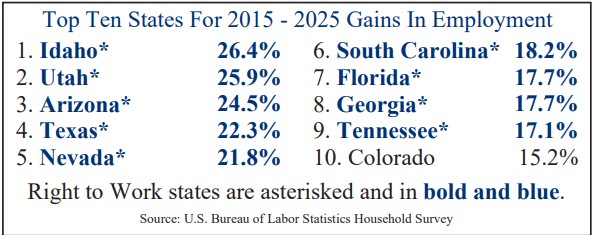
The BLS’s household survey data show that, from 2015 to 2025, the 24 states that continuously had Right to Work protections enjoyed an overall employment increase of 9.82 million.
The number of employed people in those 24 states grew by a healthy 15% in percentage terms, despite the travails of the COVID-19 pandemic and the hostile national environment for private sector job creation during the Biden Administration.
Meanwhile, aggregate employment in the 23 states that never enacted or implemented Right to Work laws grew by just 5.8%, barely more than a third as much.
Mr. Mix commented:
“The employment growth rate of Right to Work states has greatly exceeded that of forced-unionism states for decades.
“In 2011, when we had only 22 Right to Work states, roughly 40% of the employed population resided in one. That was double the share we had in 1955, when the National Right to Work Committee was founded.”
“Expanding the number of employees with Right to Work protections is a key reason why we pour a huge share of the Committee’s resources into our survey program,” added Mr. Mix.
“Since 2011, four more states have gained Right to Work laws with the assistance of our grassroots activists.
“Today roughly 48%, or nearly half, of all U.S. workers live in a state free from compulsory unionism.
“The stellar employment growth trends in states like Idaho, Nevada, Tennessee, and South Carolina should reconfirm for politicians the efficacy of Right to Work as a means to promote prosperity and ward off the stagnation that is occurring in the states where union kingpins exercise the most control.
“You can be assured our members know that, and will hold politicians accountable with that knowledge over the course of the rest of the primary season on into November.”
This article was originally published in our monthly newsletter. Go here to access previous newsletter posts.
To support our cause and help end forced unionism, go here to donate.

Committee President Mark Mix: “If I were a Leatherman dockworker, I certainly wouldn’t count on Longshore Union bosses to show any flexibility” to get the terminal reopened and “save my job.”

According to AFSCME Local 1632 President Will Harmon, Columbus Water & Power committed a grievous offense by subcontracting out the job of clearing away invasive weeds and brush spread out across two acres of its property to a tribe of roughly 40 goats without first “negotiating” with Big Labor.
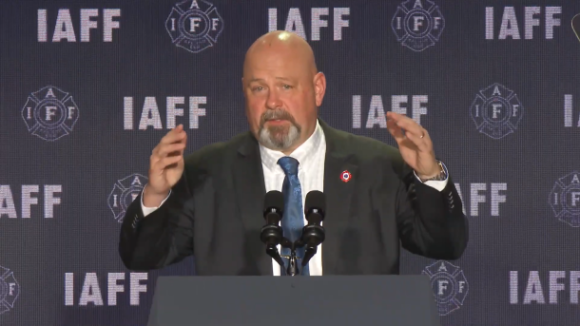
One longtime IAFF official who is now in the spotlight for his crass denigration of “two-hatters” -- that is, professional firefighters who also serve as volunteers -- is Pennsylvania Democrat politician Bob Brooks.