Radical Teacher Unions Get Even More Radical
Incoming NEA President Princess Moss: Teachers Must Be Full-Time Political Activists
Michael Hicks is director of the Center for Business and Economic Research and an associate professor of economics at Ball State University understands how Right to Work will help Indiana create jobs and grow. Too bad the sitting Republican governor, Mitch Daniels, does not.
Right-to-work legislation is once again at issue in Indiana and a dozen other states where it would have been unthinkable only a few years ago. It is a good time to review what economists know and do not know about the effects of Right to Work.
To begin with, it seems pretty clear to me that unions have, and always will be, a part of the economic landscape. They’ve been with us in some fashion for at least a millennium and nothing survives that long without benefiting its members. But there are different types of unions. Most professional organizations and trade unions play a role in labor quality and promotion of the industry. Government unions act primarily as bargaining units, while private sector industrial unions have a very different history. It is these latter two that right-to-work legislation targets.
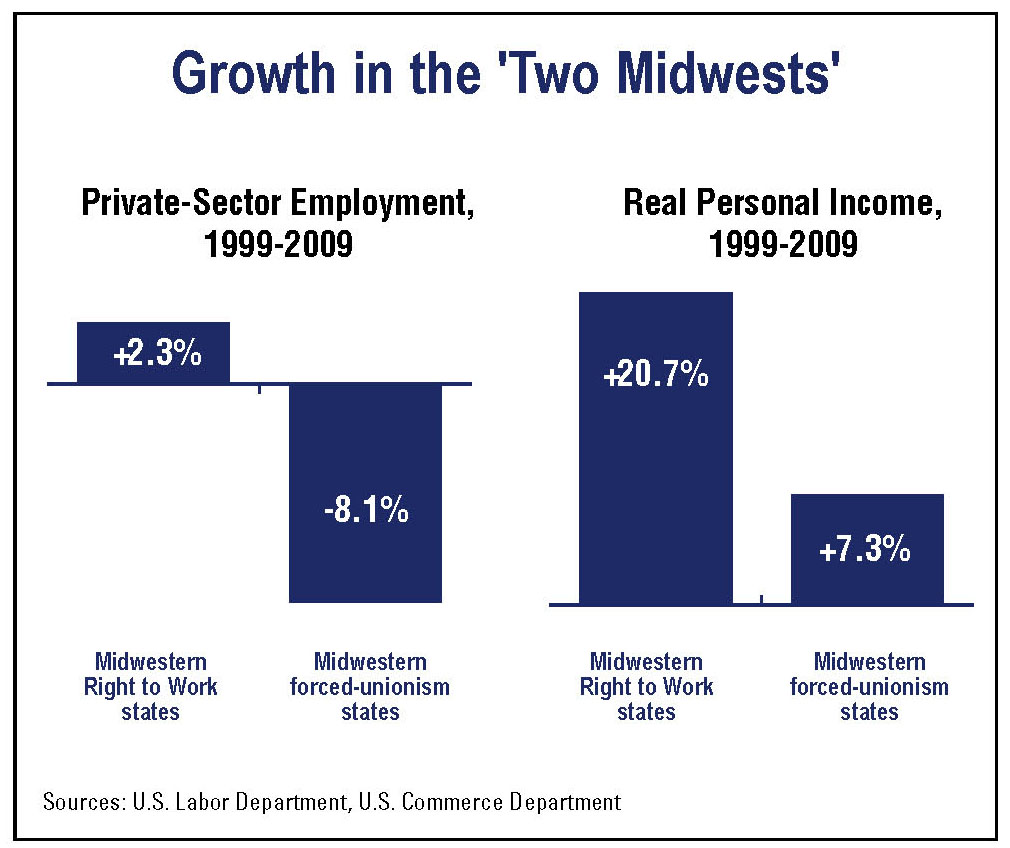
There is abundant research on the economic effects of right to work by economists of both the right and left. The results are pretty clear that right-to-work legislation leads to increased employment. Several studies at the county and state level that account for myriad other factors and trace the issue as far back as the 1940s support this finding. The only questions are (1) is it right to work alone, or other pro-business policies, that boosts job growth? And (2) how big might the job growth be?

Incoming NEA President Princess Moss: Teachers Must Be Full-Time Political Activists

Union bosses are rallying behind Democrat Texas U.S. Senate candidate James Talarico because he opposes Right to Work protections for employees.
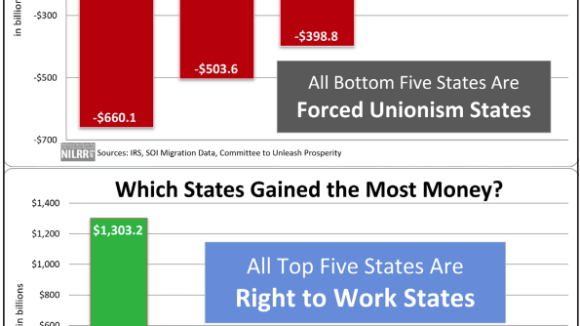
... States that continuously lacked Right to Work protections for employees from 2012-23 lost a net total of $2.05 trillion in cumulative AGI solely as a consequence of domestic out-migration of taxpayers during that 11-year period.