Big Labor’s Multi-Billion-Dollar Power Grab
Union bosses are rallying behind Democrat Texas U.S. Senate candidate James Talarico because he opposes Right to Work protections for employees.

Three companies are expanding soon in Right to Work North Carolina. After all, Right to Work economies are perfect environments for business growth. These businesses are WestRock Company and Hubbell Power Systems, as well as Pöppelmann Plastics USA. Altogether, they will invest over $75 million toward the states economy. In addition, they will also create a total of 256 new jobs. So this is exciting news!
Read on so you can learn more about each investment!
WestRock Company is investing $47 million in order to expand in Right to Work Claremont, North Carolina. This will create 50 new jobs!
“WestRock is proud to be part of the Claremont community, and we look forward to growing our team in the area. […] This facility is an important part of WestRock’s production of sustainable, fiber-based packaging. We are [glad] to make this investment in Catawba County.” […]
“North Carolina provides a reliable infrastructure and manufacturing workforce for the global operations of companies like WestRock. […] As outlined in our First in Talent plan, we will continue investing in our greatest asset, North Carolina’s talented and diverse people, and preparing them to be the world-class workforce that world-class companies need.”
AREA DEVELOPMENT MAGAZINE
Hubbell Power Systems is investing $8.9 million in order to expand in Right to Work Rocky Mount, North Carolina. This’ll create 73 new jobs.
“We appreciate the current and past support of the local community and the State of North Carolina. […] This expansion allows us to meet the current and growing future needs of our customers, while providing job growth opportunities for people in the Rocky Mount community.” […]
“I’m pleased to see Hubbell Power Systems will expand their PenCell Plastics’ site in North Carolina. […] There’s a reason North Carolina is the number one manufacturing state in the Southeast U.S., and expansions like this one demonstrate our workforce training and infrastructure investments are paying dividends.” […]
AREA DEVELOPMENT MAGAZINE
Pöppelmann Plastics USA is investing $19.2 million in order to expand in Right to Work Claremont, North Carolina. This will create 133 new jobs!
“Today is a wonderful day for Pöppelmann Plastics USA and our parent company, Pöppelmann GmbH & Co. KG. […] Though this expansion is just beginning, it is the culmination of years of strategic growth and planning to diversify the Claremont operation. It will allow us to grow all divisions of our business (TEKU, K-TECH, KAPSTO) by supplying the automotive OEMs (original equipment manufacturers) and the horticultural industry on a greater scale in the United States, and Canada. We appreciate the encouragement of our parent company, the dedication of our hard-working Pöppelmann Plastics USA employees and the support of the city, county and state to bring this day to fruition.” […]
“We are pleased with Pöppelmann’s decision to expand their U.S. production facility here in North Carolina. […] North Carolina companies know that our infrastructure, quality of life and capable workforce are great advantages in their success.” […]
AREA DEVELOPMENT MAGAZINE
To read the previous update on economic development in Right to Work North Carolina, click here.
To support our cause, go here to donate.
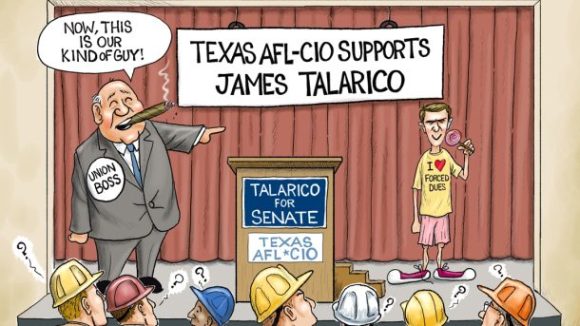
Union bosses are rallying behind Democrat Texas U.S. Senate candidate James Talarico because he opposes Right to Work protections for employees.

... States that continuously lacked Right to Work protections for employees from 2012-23 lost a net total of $2.05 trillion in cumulative AGI solely as a consequence of domestic out-migration of taxpayers during that 11-year period.
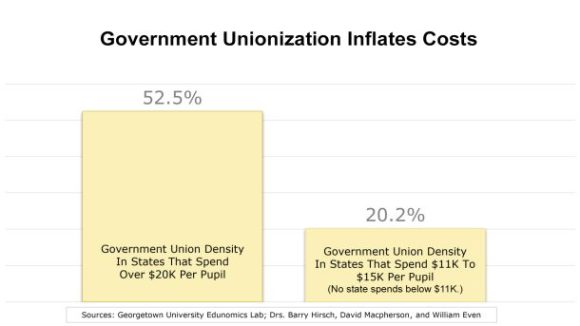
“[L]ast month, state legislation championed by AFSCME and coalition partners [...] was reintroduced to expand collective [monopoly] bargaining . . . to all Virginia public [workplaces]. It is supported by Gov. Abigail Spanberger.”