A good day for First Amendment Rights:
The Supreme Court ended its term in style Monday with two blockbuster rulings curbing the abuse of political power and relieving men and corporations who have been ordered to act against conscience. Home health care providers will no longer be forced to fund political campaigns against their will, nor can companies be compelled to pay for birth control devices and abortion under Obamacare.
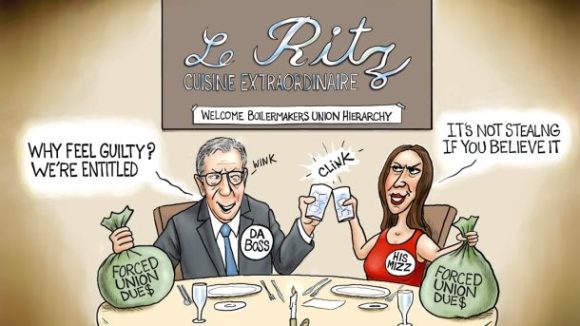
These are big defeats for increasingly brazen “progressives,” as they now call themselves, who have devised clever schemes to shower money on Democratic candidates. Politicians in more than a dozen states have enacted programs to force independent contractors who are paid through Medicaid to join public sector unions. Every new employee must pay dues, which are returned to Democratic politicians in the form of campaign donations.
Pamela Harris, a mother in Illinois, was forced to pay union dues because Illinois provides her a modest subsidy from Medicaid so she can stay at home to care for her son, Joshua, who suffers a rare genetic disorder.
In a classic case of the “Chicago Way,” Illinois Gov. Pat Quinn issued an executive order in 2009 authorizing the state to recognize the Service Employees International Union as an “exclusive representative” for home health providers like Mrs. Harris. Mr. Quinn’s order effectively swept 4,500 men and mostly women offering home care for the disabled into the unwanted embrace of government employee unions.
Mrs. Harris didn’t want to share her modest pay with a distant union boss, so she turned to the National Right to Work Legal Defense Fund to argue that her First Amendment rights were violated. Legislators in Illinois defended their scheme by claiming the at-home workers enjoy the “benefits” of union representation, so they ought to pay dues.
Writing for the majority, Justice Samuel Alito swept away the state’s reasoning. “The mere fact that nonunion members benefit from union speech is not enough to justify [imposition of a union] fee…,” he wrote. “If we accepted Illinois’ argument, we would approve an unprecedented violation of the bedrock principle that, except perhaps in the rarest of circumstances, no person in this country may be compelled to subsidize speech by a third party that he or she does not wish to support.” (from the Washington Times)