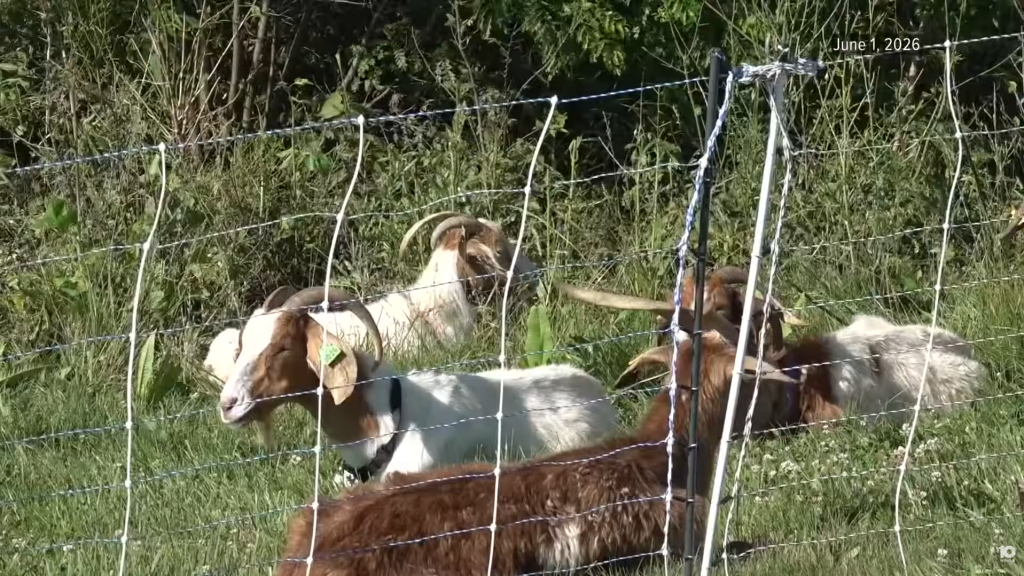
According to government union bosses, Columbus officials can’t subcontract out to a tribe of goats the job of clearing away invasive weeds and brush from public property without first “negotiating” with Big Labor. (Credit: WBNS 10TV (CBS, Columbus, Ohio))
Ever since Big Labor politicians across the U.S. started passing laws handing monopoly-bargaining power over public workplaces to government union officials more than six decades ago, news stories about off-the-wall grievances such union bosses have threatened to file or actually filed have proliferated.
In 2009, for example, Pennsylvania-based Service Employees International Union (SEIU) local President Nick Balzano raised hackles when he threatened legal action against the city of Allentown for, as a Fox News report put it, “allowing a boy scout to voluntarily clear a walking path in a local park.”
Big Labor Grievance Against Boy Scout Project Outraged Ordinary Citizens
There was a powerful public backlash against Mr. Balzano for insisting that the volunteer work done by then-17-year-old Kevin Anderson and his fellow scouts, along with their friends and parents, should instead have been done at taxpayers’ expense by government employees who pay dues to the SEIU.
So powerful, in fact, that other SEIU bosses declined to back Mr. Balzano up. He soon submitted his resignation.
Unfortunately, in 2026 it seems that union bigwigs are beyond shame. This summer, local American Federation of State, County and Municipal Employees (AFSCME) union bosses in Columbus, Ohio, are moving ahead with a grievance against the city’s wastewater treatment plant for using union-free labor to clear away brush and weeds located near the facility.
Goats Can Allow Humans to Avoid Dangerous Labor, But Union Bosses Don’t Care
According to AFSCME Local 1632 President Will Harmon, Columbus Water & Power committed a grievous offense by subcontracting out the job of clearing away invasive weeds and brush spread out across two acres of its property to a tribe of roughly 40 goats without first “negotiating” with Big Labor.
The city determined that using goats for vegetation management is the best way to get rid of poison hemlock and other weeds located on a slope. As a June 26 Washington Post editorial explained, goats are especially useful in areas where the “terrain makes it difficult, even dangerous, for humans to use heavy equipment.”
National Right to Work Committee President Mark Mix commented:
“Under America’s representative system of government, decisions regarding how to use taxpayers’ money efficiently and effectively to maintain public property should be made exclusively by elected officials and their appointees.
“Government union bosses like Mr. Harmon have no incentive to act in taxpayers’ best interest. Nevertheless, because Ohio authorizes and promotes union monopoly bargaining in the public sector, they act as co-managers of state and local government employees.
“And they can impose harmful and unpopular policies on the public without the risk of ever being removed from power on Election Day or fired by an elected official who is unhappy with their performance.”
Ohio’s current law effectively barring elected officials from deciding how vast numbers of front-line civil servants are compensated and managed is part of a downhill trend launched by Democrat President John F. Kennedy.
In 1962, JFK issued an executive order “temporarily” permitting Big Labor “exclusive” bargaining in federal workplaces.
‘Elected Officials [Lack] Effective Authority Over The Operations of Government’
Today, monopolistic unionism is undermining American representative government at all levels. The crisis was summed up well by attorney, author, and civic leader Philip Howard in his book, NOT Accountable: Rethinking the Constitutionality of Public Employee Unions: “Elected officials — the president, governors, and mayors — no longer have effective authority over the operations of government. Nor do their appointees. Nor do public supervisors, such as school principals, police captains, and crew chiefs on highway repair teams.”
The dispute over whether Columbus officials can, without getting Big Labor permission first, pay a contractor $2,900 in order to send goats to eat up invasive plants located on a small patch of public property may seem funny at first.
But the Ohio “goat imbroglio” is actually another laughable illustration of an issue that is deadly serious: Should all voting-eligible American citizens have an equal say in how our government is run, or should a handful of union chiefs have much more say than the rest of us?