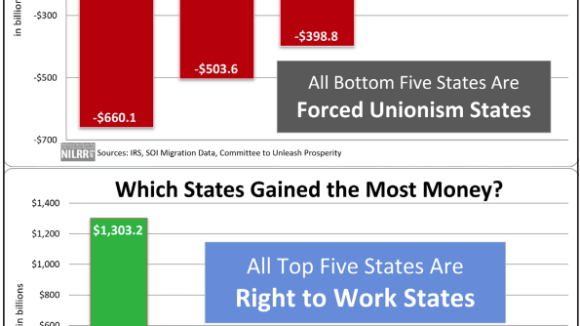
Virginia’s solid Right to Work foundation has helped keep its state budget in the black, its people working, and made it an attractive place for businesses to locate. More importantly it allows Virginia to lived up to Patrick Henry’s words demanding “Liberty.”
New Hampshire has the opportunity to live up to its motto and “Live Free” by overriding Gov. John Lynch’s veto of freedom.
Lynch, who is heavily financed by forced-union dues given to him by Big Labor bosses, chose to thwart freedom for working men and women. Somehow, Lynch decided it is more just to require people to be forced to pay tributes union bosses against their will that to let struggling workers in New Hampshire decide if they should keep their own wages or choose to share some with a union. Encourage your legislators to override Gov. Lynch’s veto of “Freedom” and “Liberty.”
He received the loudest applause when he mentioned the need to tap the nation’s natural resources as part of a complete energy plan and to turn New Hampshire into a right-to-work state.
“We have a country that is now facing some tough issues,” he said. “It is time for a change.”