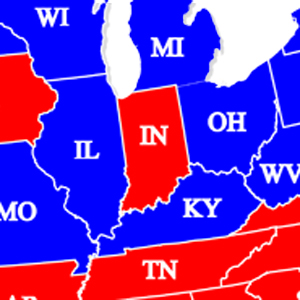
Indiana Workers Ask to File Amicus Brief Defending Hoosier Right to Work Law
From the National Right to Work Legal Defense Foundation: Union lawyers seek to shut workers out of the proceedings Hammond, IN (April 2,…
With the Democrat National Committee (DNC) short on funds needed for their national convention this year, Democrat party leaders have turned to Big Labor Bosses to ask that they their union treasuries pay the freight. In 2008, Big Labor…
From BigGovernment.com: In Knox v SEIU, the illogic of requiring non-union members to provide interest-free loans for Big Labor political activities comes under the Supreme Court’s scrutiny. In this…
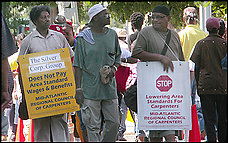
The 11th Circuit Court of Appeals has upheld a $1.7 million jury verdict against the Carpenters Union for illegal activities targeted at a non-union contractor. The campaign included union picketers, mostly homeless people paid by the union, were transported in the union’s…
Minnesota Judge Dale Lindman ruled that Gov. Mark Dayton's Executive Order (EO) calling for the unionization of child care providers is unconstitutional. Judge Lindman, an appointee of Gov. Arne Carlson, said that Gov. Dayton's EO is "an unconstitutional usurpation of the Legislature's right to create or amend laws", which "is a violation of the Separation of Powers principle." The Examiner called it s "stinging defeat for Gov. Dayton, AFSCME and the SEIU." Judge Lindman said that the BMS doesn't have statutory authority through Chapter 179 to get involved in this dispute, adding that they only have the authority to mediate in employer-employee disputes. HotAir.com weighs in on the news: Dayton attempted to bypass the state legislature in this effort by declaring through executive order that day-care centers that indirectly receive state aid through their clients are in effect public-sector workplaces — a definition not found in law or in legislative intent. In fact, as Gary Gross points out, it arguably contravenes state law. That way, Dayton could order an election that would allow his union allies to force their way into day-care workplaces, including many independent operations, and start extracting dues on a massive basis. I use the word extreme for a couple of reasons. First, it fits; had Dayton succeeded in his imposition of public-worker status, the precedent established would have been so broad as to threaten the very notion of a private-sector workforce altogether.

Right to Work Fights Back Against 'Illegal' NLRB Appointments (source: National Right To Work Committee February 2012 Newsletter) Under Article II, Section 2 of the U.S. Constitution, the President has the power to appoint "officers of the United States," but only "by and with the advice and consent of the Senate." The Constitution makes it clear that only in cases when "vacancies . . . happen during recesses of the Senate" may the President make temporary "recess" appointments to offices that normally require confirmation by Congress's upper chamber. Unfortunately, in his eagerness to please union officials Inside the D.C. Beltway, a tiny but crucial constituency for his re-election bid this year, Democratic President Barack Obama is now seeking to render the Constitution's "advice and consent" requirement for executive appointments effectively meaningless. Early this January, the Senate was not in recess. For several weeks starting last December 20, the Senate was instead in a "pro forma" session during which it did not meet every day, but did periodically conduct business under "unanimous consent" agreements. No one can reasonably argue that this "pro forma" session was tantamount to a recess. Article I, Section 5 of the Constitution states that neither the House nor the Senate may over the course of a Congress "adjourn for more than three days" without "the consent of the other." A La Humpty Dumpty, Mr. Obama Insists 'Recess' Means Whatever He Says It Means As syndicated columnist Michael Barone has explained: "The House did not consent to the adjournment of the Senate this year, so there is no recess, and hence no constitutional authority to make recess appointments."