Union-Only Port Terminal Suspends Operations
Committee President Mark Mix: “If I were a Leatherman dockworker, I certainly wouldn’t count on Longshore Union bosses to show any flexibility” to get the terminal reopened and “save my job.”
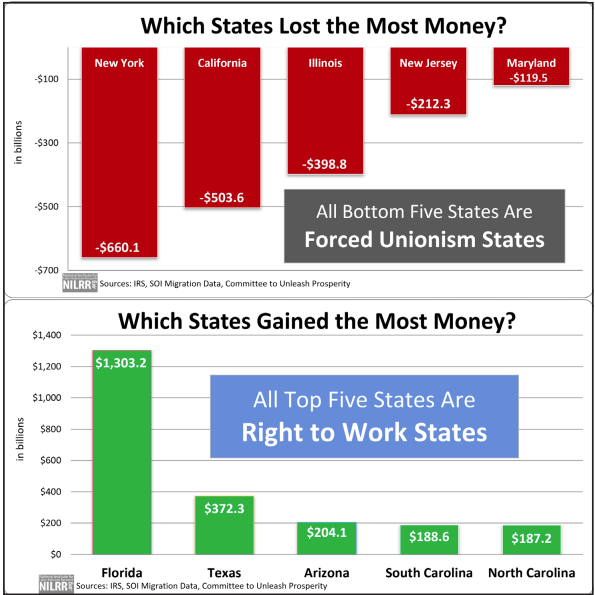
For many years, data from the Internal Revenue Service (IRS) have shown how states like California, Illinois, and New York are paying a high price for allowing dues-hungry union bosses to get workers fired for refusing to bankroll their organizations.
Year after year, far more taxpayers have been leaving forced-dues states than moving into them. The cumulative net losses in taxpayers and their income have been cutting into these states’ tax revenue bases.
The latest taxpayer migration data furnished by the IRS show that the 23 states then lacking Right to Work laws, banning forced union fees as a job condition, lost a total of $40 billion in income due to the net out-migration of taxpayers occurring in the single year before they filed their tax returns for 2022.
However, as economist Steve Moore noted in a recent letter to the editor of the Wall Street Journal, annual IRS data tracking the interstate migration of taxpayers and their income tell “only a sliver” of the story.
The reason why is quite simple: The IRS does not track how much fleeing taxpayers earn any later than the first year after they depart. Inevitably, the IRS data understate forced-dues states’ accumulating income losses — and by a lot.
As the Committee to Unleash Prosperity, a Maryland-based nonprofit cofounded by Mr. Moore, explains, “income doesn’t freeze when it crosses a state line.”
For example, the taxpayers “who moved to Florida in 2013” didn’t bring just one year apiece of earnings. Practically every one of them brought “a career, a spending pattern, [and/or] a tax footprint that continued generating economic activity, year after year.”
To furnish information about each of the 50 states’ estimated cumulative net gains or losses of income and people over multi-year periods, Mr. Moore and his colleagues launched the Vote With Your Feet Project, a data platform.
This spring, the National Institute for Labor Relations Research collected the migration data on this platform to get a far more accurate picture of the cumulative income losses forced-unionism states are enduring due to net domestic outmigration than the IRS can provide.
The Vote With Your Feet Project data showed that the 23 states that continuously lacked Right to Work protections for employees from 2012-23 lost a net total of $2.05 trillion in cumulative adjusted gross income (AGI) solely as a consequence of domestic out-migration of taxpayers during that 11-year period.
Nine forced-unionism states lost a total of between $105 billion and $660 billion apiece.
Overall, the 23 states that continuously had Right to Work laws on the books from 2012 to 2023 enjoyed a net gain of $2.46 trillion thanks to taxpayer in-migration from other states.
The six biggest gainers, in absolute terms, are all Right to Work states.
As a consequence of the massive net losses of income it experienced from 2012 onward by means of “foot voting,” forced-unionism California’s 2023 AGI was slashed by 11.8%, according to the Moore team’s estimate.
Forced-unionism Illinois’s 2023 aggregate AGI was 20.7% lower than it would have been. And net taxpayer out-migration cut forced-unionism New York’s 2023 AGI by 21.1%!
“Obviously, losses of taxpayer income of this magnitude make it far more burdensome for taxpayers who remain to cover the cost of government in Big Labor-dominated jurisdictions like California, Illinois, and New York,” observed National Right to Work Committee Vice President John Kalb.
“And this year, union boss-owned politicians in Sacramento, Springfield and Albany are greenlighting costly additional taxpayer-funded handouts for public-sector union bosses, practically ensuring that their already troubled state finances will face even more severe problems in the future.”

“Fortunately,” continued Mr. Kalb, “with ample help from National Right to Work’s state Survey 2026 program, grassroots, tax-paying citizens in state after state are now fighting back against Big Labor and its puppet politicians.
“In this program, the National Committee is teaming up with a number of state and regional Right to Work groups to urge state candidates of all stripes to pledge to oppose forced unionism across the board, and mobilize ordinary freedom-loving citizens to contact those same candidates.
“This program’s goal is to generate an avalanche of support for Right to Work in the days leading up to both primary and general elections for key state legislative and executive-branch offices.
“In states like Montana and New Hampshire, which have never had Right to Work protections for employees up to now, the Committee and its allies’ aim this year is to forge majority support in both legislative chambers for revoking Big Labor’s forced-dues privileges.
“That would pave the way for passage of new state Right to Work laws in 2027.”
Another important 2026 state battleground for Right to Work supporters is Michigan.
“In late 2012,” recalled Mr. Kalb, “pro-Right to Work citizens dealt a bitter blow to union bosses nationwide by securing enactment of a ban on forced union dues and fees as a job condition in Michigan, which had for decades been considered to be an impregnable Big Labor stronghold.
“Unfortunately, in 2023, the union hierarchy was able to wipe Michigan’s Right to Work law off the books by persuading razor-thin Democrat majorities in the state’s General Assembly to defy public opinion and bring back forced unionism.
“But in the 2024 elections, thanks in large part to the state Survey program, the anti-Right to Work majority in the Michigan House of Representatives was obliterated.
“If Michiganders can keep the momentum going this year, they may soon have their Right to Work law back.”
A third group of states where the Survey 2026’s efforts will be especially critical includes Right to Work Nevada and Wisconsin.
“Employees and small business owners in Nevada and Wisconsin are clearly better off than they would be if forced unionization were permissible in those states,” said Mr. Kalb.
“Nevertheless, Nevada Democrat gubernatorial nominee Aaron Ford, who has been running neck-and-neck with incumbent GOP Gov. Joe Lombardo in the polls, is openly pledging to destroy Right to Work next year if he is elected and gets the opportunity.
“Meanwhile, all of the leading candidates in Wisconsin’s Democrat gubernatorial primary, which is scheduled to occur a few weeks after this Newsletter edition goes to press, are similarly vowing to destroy the Badger State’s 11-year-old Right to Work law if they can.”
This article was originally published in our monthly newsletter. Go here to access previous newsletter posts.
To support our cause and help end forced unionism, go here to donate.
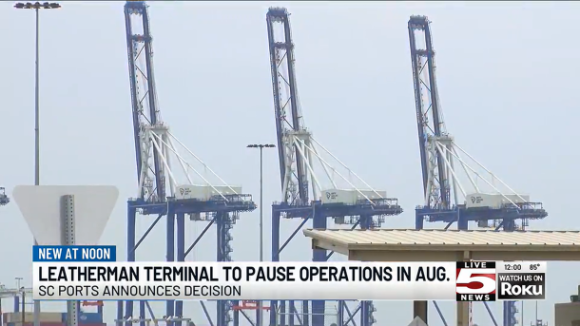
Committee President Mark Mix: “If I were a Leatherman dockworker, I certainly wouldn’t count on Longshore Union bosses to show any flexibility” to get the terminal reopened and “save my job.”

According to AFSCME Local 1632 President Will Harmon, Columbus Water & Power committed a grievous offense by subcontracting out the job of clearing away invasive weeds and brush spread out across two acres of its property to a tribe of roughly 40 goats without first “negotiating” with Big Labor.
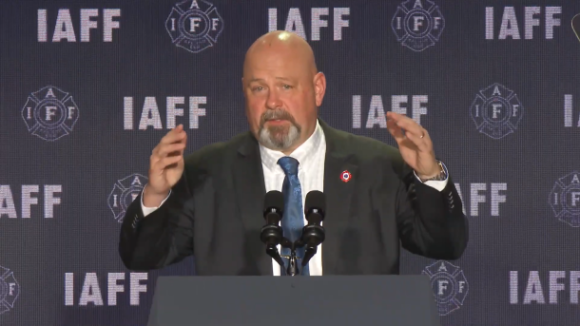
One longtime IAFF official who is now in the spotlight for his crass denigration of “two-hatters” -- that is, professional firefighters who also serve as volunteers -- is Pennsylvania Democrat politician Bob Brooks.