Big Labor’s Multi-Billion-Dollar Power Grab
Union bosses are rallying behind Democrat Texas U.S. Senate candidate James Talarico because he opposes Right to Work protections for employees.
Companies are choosing to invest in Right to Work Arizona as a result of the state’s economic benefits. The most recent companies adding new locations in Right to Work Arizona include JX Nippon USA and Heritage Battery Recycling, as well as Corning. Altogether, this will create 460 new jobs. So this is exciting economic news! Read on in order to learn more about each individual company’s plans.
JX Nippon Mining & Metals USA has officially begun building a new facility in Right to Work Mesa, Arizona. This will also create 100 new jobs!
“JX Nippon Mining & Metals USA, Inc. is a cutting-edge electronic materials manufacturer. […] We are proud to be moving forward on our commitment to manufacture electronic materials in the City of Mesa. With an outstanding team of designers and engineers, and a product strategy, we expect today to be just the start of a longstanding presence in this dynamic city.” […]
“Today’s groundbreaking showcases Arizona’s premier attractiveness for the semiconductor industry. […] JX USA has been a leading advanced materials developer in Arizona for more than 30 years, and we are excited to see them expand their legacy in Mesa.”
AREA DEVELOPMENT MAGAZINE
Heritage Battery Recycling is adding a new facility soon in Right to Work Elroy, Arizona. This will also mean 110 new jobs!
“The lithium-ion battery market is expected to grow exponentially over the next several years, with a projected market size approaching $25 billion by 2028.” […]
“This new EV battery recycling facility bolsters Arizona’s vibrant battery and electric vehicle supply chain and furthers Arizona’s reputation as an epicenter for lithium batteries. […] The innovative facility will produce battery materials to support the continued growth of electric vehicle manufacturers across Arizona and the United States. Arizona continues to be a magnet for technology and advanced industries.”
AREA DEVELOPMENT MAGAZINE
Corning Incorporated is adding a new location soon in Right to Work Gilbert, Arizona. This will create 250 new jobs as a result!
“We believe access to broadband means access to opportunity, from education to healthcare to quality of life. […] Corning is doing our part to make sure everyone, regardless of where they live, has access to reliable, high-speed connections enabled by optical fiber. […]
“Corning’s new cable manufacturing facility demonstrates Arizona’s attractiveness as a leader in manufacturing and technology. […] We’re thankful for Corning’s investment in Gilbert, creating hundreds of new jobs in the community while increasing connectivity.” […]
“Greater Phoenix is a community that embraces and supports opportunity and collaborative innovation. […] The optical cable created at Corning’s Gilbert manufacturing facility will enable the next generation of entrepreneurs, provide stability, connectivity and jobs to the region and improve the lives of our growing population. We’re excited to welcome this investment into our community and to partner in Corning’s continued growth and success.”
AREA DEVELOPMENT MAGAZINE
To read the previous update on economic development in Right to Work Arizona, click here.
To support our cause, go here to donate.
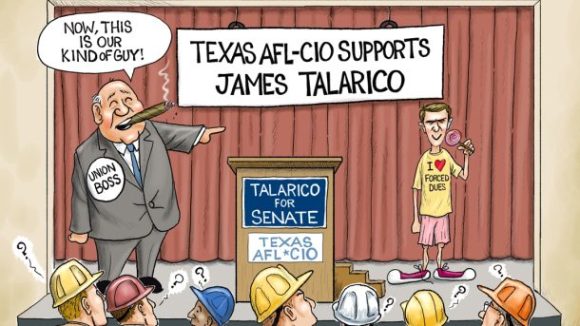
Union bosses are rallying behind Democrat Texas U.S. Senate candidate James Talarico because he opposes Right to Work protections for employees.
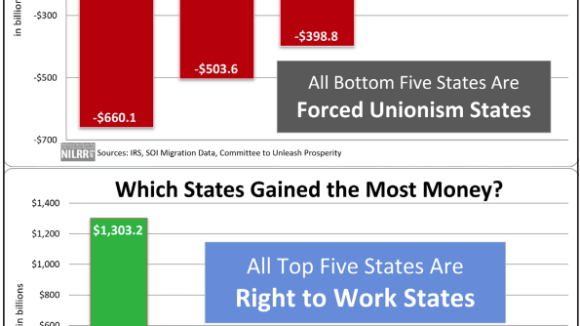
... States that continuously lacked Right to Work protections for employees from 2012-23 lost a net total of $2.05 trillion in cumulative AGI solely as a consequence of domestic out-migration of taxpayers during that 11-year period.
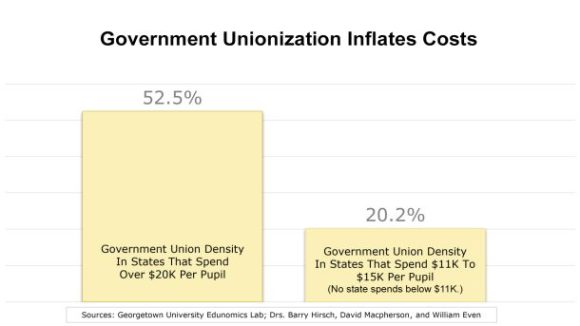
“[L]ast month, state legislation championed by AFSCME and coalition partners [...] was reintroduced to expand collective [monopoly] bargaining . . . to all Virginia public [workplaces]. It is supported by Gov. Abigail Spanberger.”