Big Labor’s Multi-Billion-Dollar Power Grab
Union bosses are rallying behind Democrat Texas U.S. Senate candidate James Talarico because he opposes Right to Work protections for employees.

From year to year polls consistently show that around 8 in 10 Americans reject the idea that someone should be forced to bankroll unwanted union boss activities just to keep his or her job. Similarly, polls have found that even 80% of union members believe union membership and dues should be voluntary and not a condition of employment.
Mark Mix, Boston Herald
These are words from National Right to Work Foundation and Committee President Mark Mix as published in the Boston Herald and they ring true. This data is no surprise either, and here’s why:
According to the Labor Department, from April 2020 to April 2021, Right to Work states posted a recovery in manufacturing payroll jobs roughly 60% stronger than that of forced-unionism states during the same time period.
Sluggish job growth in forced-unionism states was not limited to just the pandemic recovery. A National Institute for Labor Relations Research analysis points out that, from 2020 back to 2010, employment in states lacking Right to Work protections increased by only 2.4%, paling in comparison to Right to Work states’ 11.0% jump in the same decade. […]
And people don’t just flock to Right to Work states for the jobs: the NILRR analysis points out that, based on Bureau of Labor Statistics data, the mean after-tax household income in Right to Work states is about $4,300 higher than the average for households in forced-unionism states, after adjusting for cost of living.
Business experts also regularly point out that Right to Work plays a major role when a company is deciding where to expand an existing plant or facility or where to create a new one. In the manufacturing sector alone, the NILRR analysis notes, payroll employment in Right to Work states grew by 9.1% while falling by 0.2% in forced-unionism states, during 2010 to 2020.
Mark Mix, Boston Herald
So there you have it. People prefer Right to Work over Forced Unionism because it has far more benefits for everyone.
If you have questions about whether union officials are violating your rights, contact the Foundation for free help. To take action by supporting The National Right to Work Committee and fueling the fight against Forced Unionism, click here to donate now.
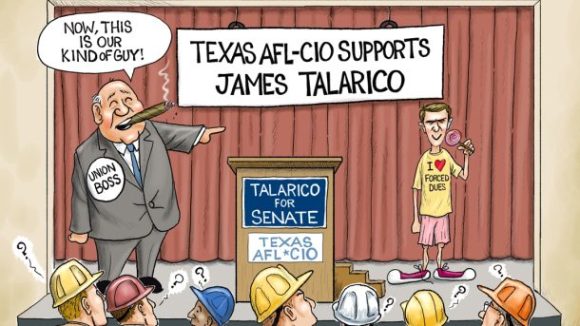
Union bosses are rallying behind Democrat Texas U.S. Senate candidate James Talarico because he opposes Right to Work protections for employees.
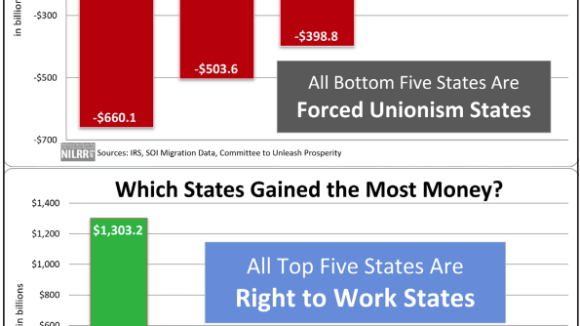
... States that continuously lacked Right to Work protections for employees from 2012-23 lost a net total of $2.05 trillion in cumulative AGI solely as a consequence of domestic out-migration of taxpayers during that 11-year period.

One of the key goals of the U.S. Department of Labor since President Donald Trump’s second term commenced in January 2025 has been to expand the number of apprenticeships in America to “at least a million.”